


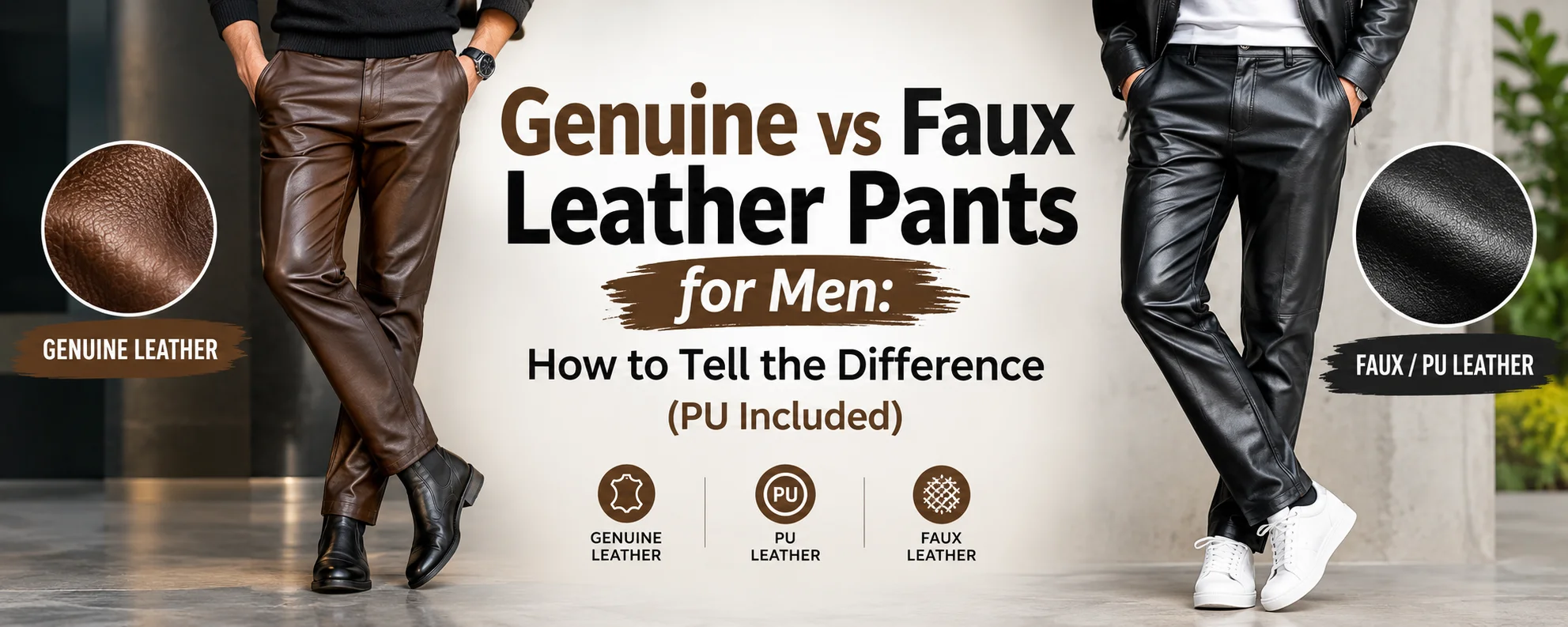
You find a pair of black leather pants online. The tag says “leather.” The price is $70. Is it real?
Maybe. Maybe not. Many pairs sold as “leather” are plastic with a leather-style print. They look great in photos, then crack after a season.
This guide to genuine vs faux leather pants for men shows you the real differences, five quick tests to spot a fake, and what label words really mean. By the end, you can pick the right pair for your budget and your wardrobe.
What Is Faux Leather?
Faux leather is a man-made material designed to look like real leather. It usually has a fabric base with a plastic coating on top.
You will see it called by many names:
- PU leather (polyurethane), the most common type
- PVC leather, a firmer, shinier plastic
- Vegan leather, which is usually PU-based
- Pleather and leatherette
- Bonded leather, made from leather scraps glued with plastic binder
All of these are different from real hide. Genuine leather comes from animal skin, usually lambskin or cowhide.
Style Tip: Real or fake, leather pants are the statement piece. Keep the rest of your outfit simple.
Genuine vs Faux Leather Pants: Side by Side
| Genuine Leather | Faux Leather (PU) | |
|---|---|---|
| Made from | Real animal hide | Fabric base with a plastic coating |
| Feel | Warm, soft, natural | Smooth, often cooler and plasticky |
| Breathability | Breathes better | Traps heat and sweat |
| Durability | Lasts for years with care | Can crack or peel with regular wear |
| Ageing | Builds a patina and softens | Coating breaks down over time |
| Care | Needs conditioning now and then | Wipes clean, no conditioning |
| Price | Higher at first | Lower at first |
| Best for | Daily wear, long-term value | One-off looks, tight budgets |
The short version: faux costs less today. Genuine usually costs less per wear.
How to Tell Real Leather from Fake: 5 Quick Tests
No single test is perfect. Use two or three together for a reliable answer.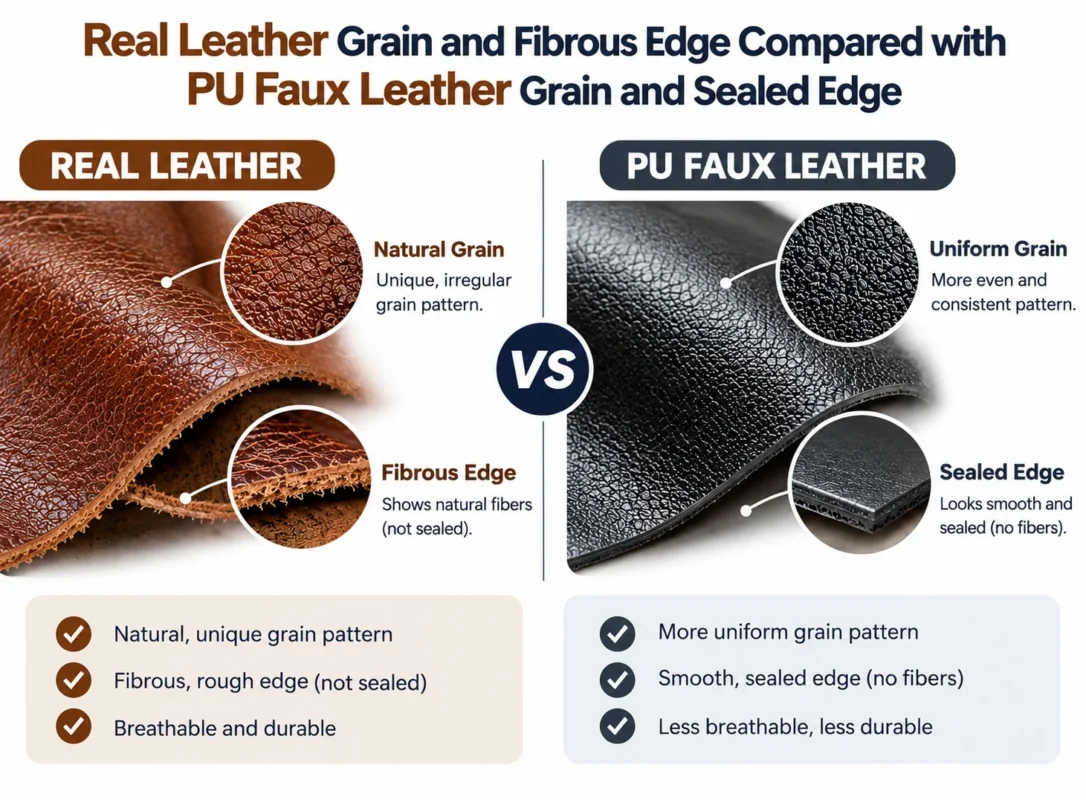
1. Check the grain. Real leather has small, uneven pores, like a fingerprint. Faux leather often has a perfect, repeating pattern that looks machine-printed.
2. Look at the edge. This is the most reliable test. Real leather has a rough, fibrous edge that looks like compressed fibres. Faux leather has a smooth, sealed edge, often with fabric showing underneath.
3. Smell it. Real leather smells earthy and rich. Faux leather smells of plastic or chemicals, or has no smell at all.
4. Try a water drop. Place one tiny drop on the surface. Real leather slowly absorbs it and darkens a little. On faux leather, the drop beads up and sits on top. Wipe it dry afterwards.
5. Bend and touch. Real leather warms in your hand and creases in soft, uneven folds. Faux leather feels cooler and creases in sharp, regular lines.
Style Tip: Black is the hardest colour to judge by eye, because dark dye hides the grain. If you are checking mens black fake leather pants against the real thing, trust the edge and smell tests first.
A word of caution: some real leather has a heavy finish and may also repel water. That is why you should combine tests, not rely on one. Do not use a burn test on pants. It damages the material and is a fire risk.
What the Label Really Tells You
Sellers often use vague words like “premium” or “luxury.” Here is what common label terms mean:
| Label says | What it usually means |
|---|---|
| Full grain / top grain leather | Real leather, higher grades |
| Genuine leather | Real hide, but often a lower grade |
| Bonded leather | Scraps glued together, mostly plastic binder |
| PU, polyurethane, vegan, synthetic, man-made material | Faux leather, not animal hide |
| “Leather-look,” “leatherette,” “pleather” | Faux leather |
“Genuine leather” does mean real hide. But it is often the entry grade, not a sign of top quality. For more on grades, read our guide on why genuine leather pants are worth the investment.
Quick rule: If the product page never names the leather type, ask before you buy.
What Happens to Faux Leather Pants Over Time
Faux leather does not wear in. It wears out.
The plastic coating sits on top of a fabric base. With heat, sweat, sunlight and regular bending at the knees and seat, that coating can start to flake, crack or peel. Once it starts, you cannot fix it. Care does not stop the coating from breaking down.
Real leather has no coating to peel. It can scuff and dry out, but conditioning keeps it soft. Over time it softens, moulds to your legs and builds a patina.
Style Tip: Check the knees, seat and pocket edges first. These spots show wear before anything else.
When Faux Leather Pants Make Sense
Faux leather is not always the wrong choice. It can work if you:
- want leather pants for one event or a costume
- are testing the style before you commit
- need a very low upfront price
- want something you can wipe clean in seconds
Genuine leather makes more sense if you:
- plan to wear them often, for years
- want pants that feel better with age
- care about breathability and comfort
- think in cost per wear, not price tag
- Quick rule: Faux for a one-off look, genuine for a long-term pair.
Your Pre-Purchase Checklist
Before you pay, run through this list:
- Read the product page for the leather type and grade.
- Look for words like PU, synthetic or man-made. If they appear, it is faux.
- Check close-up photos of the edge and grain.
- If the pants are in your hands, do the edge, smell and water-drop checks.
- Check the stitching, zip and lining.
- Compare the size chart with your waist and inseam.
Want help with fit and style? Our complete guide to choosing men’s leather pants covers it step by step.
Ready for the Real Thing?
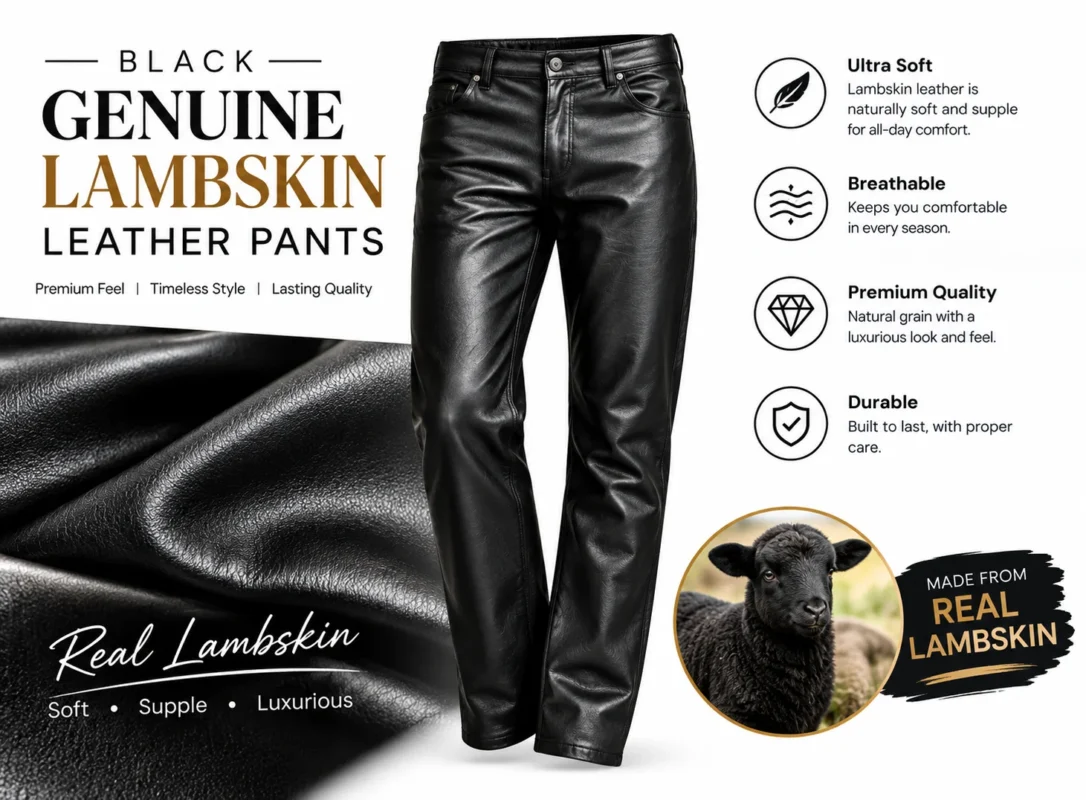
If you want a pair that lasts, see our range of genuine leather pants for men, made from real lambskin and cowhide.
FAQs
1. Is PU leather real leather?
No. PU leather is a synthetic material made from a fabric base with a polyurethane coating. It is not animal hide.
2. How can I tell if leather pants are real?
Check for an uneven grain, a rough fibrous edge, an earthy smell, and a water drop that slowly absorbs. Use at least two tests together.
3. Is genuine leather better than faux leather?
For durability, breathability and ageing, yes. Faux leather costs less upfront and is easier to wipe clean, which suits short-term use.
4. Do faux leather pants crack or peel?
They often do. The plastic coating can flake or peel with heat, sweat and regular wear, especially at the knees and seat.
5. Is vegan leather the same as faux leather?
In most cases, yes. Vegan leather usually means a PU-based synthetic with no animal material.
6. Can you tell real leather by touch alone?
Not reliably. Good faux leather can feel soft, so combine touch with the grain, edge and smell tests.
7. Is it worth paying more for genuine leather pants?
If you wear them often, usually yes. A pair that lasts for years can cost less per wear than several cheaper pairs.